
Late at night, when the house is quiet, the lights are dim, and the world outside your window has gone to sleep, your dog might be lying peacefully on the floor. Everything seems completely normal until suddenly, something changes. Your dog lifts its head, its ears twitch, and slowly, almost carefully, it turns toward the wall. At first, it doesn’t seem strange because dogs look around all the time. But then you notice something unusual: your dog isn’t just looking at the wall; it is staring completely still with its eyes locked and focused.
You call its name, but nothing happens. You clap your hands, and still, there is no response. Your dog keeps staring as if something important is happening right there. When you look at the wall, you see nothing—no bug, no shadow, no movement, and nothing at all. Millions of dog owners have asked this exact question: Why Does Your Dog Stare at the Wall? Most people grab their phones, film it, and post it with a ghost emoji and laughing reactions because it looks absurd, harmless, and a little bit funny. However, that viral moment might actually be sending an important medical or sensory signal. Let’s examine five distinct reasons why dogs do this.
Super Hearing and Hidden Wildlife Inside Your Walls
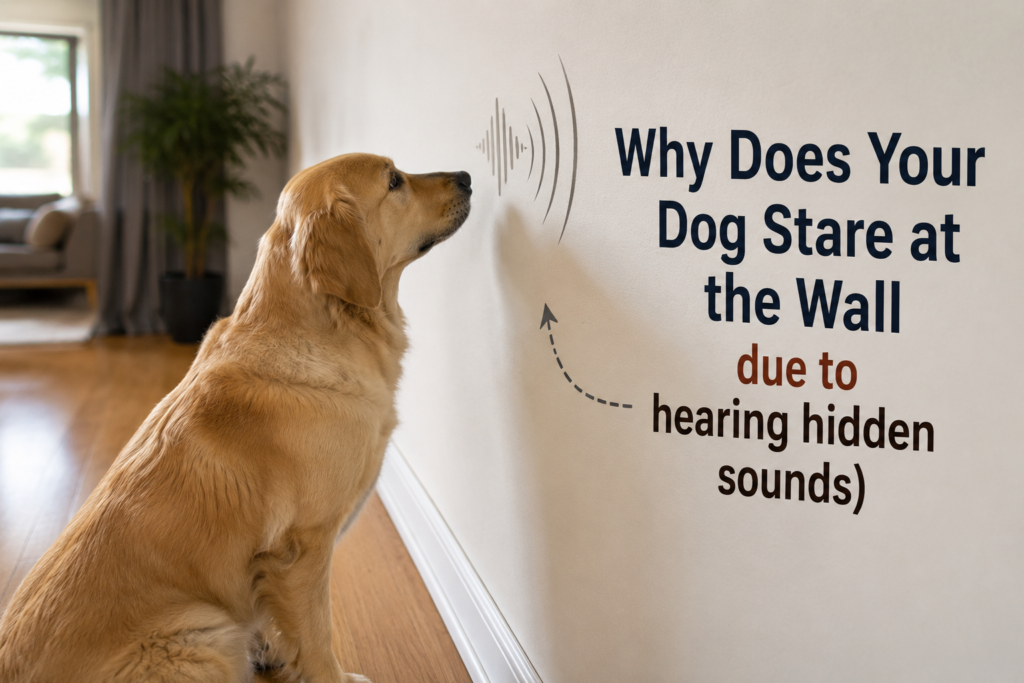
To understand why dogs stare blankly at walls, we must first recognize that dogs experience the world through senses vastly different from our own. Their senses are far more sensitive, particularly when it comes to hearing. While human hearing is quite limited—most humans can hear sounds between 20 hertz and 20,000 hertz—dogs can hear frequencies that reach nearly 45,000 hertz. This extraordinary capability means dogs can detect sounds that are completely invisible and inaudible to us, such as tiny scratches, small vibrations, and the faintest movements inside walls, ceilings, or floors.
Inside the walls of most houses, there are hidden spaces and small passages between beams and insulation. These spaces sometimes become home to small creatures like mice, rats, insects, or other tiny animals moving quietly through the darkness. These creatures create subtle sounds—a scratch, a tiny step, or a faint movement against wood or drywall. While a room feels completely silent to humans, to a dog, that same room is full of noise.
When a dog hears something unusual behind a wall, its natural survival and hunting instincts activate immediately. Long before dogs lived in houses or slept on couches, their ancestors were hunters whose survival depended on detecting even the smallest movement or sound beneath the ground. When Why Does Your Dog Stare at the Wall becomes your main question, remember that they may simply be tracking movement inside the structures with surprising accuracy, waiting patiently for a creature to reappear.
Advanced Motion Detection and the Tapetum Lucidum
Sound is only part of the story, as dogs also possess specialized vision designed for detecting motion. Inside a dog’s eyes is a structure called the tapetum lucidum. This reflective layer acts almost like a mirror inside the eye, reflecting incoming light back through the retina to allow the eye to capture more visual information. This is why dogs can see much better in low-light conditions than humans can.
More importantly, a dog’s vision is fine-tuned to detect movement rather than fine details. Even the tiniest motion can instantly capture their attention, such as:
A spider slowly crawling across a wall.
A small insect flying near the ceiling.
A drifting particle of dust caught in a beam of light.
While these things are almost invisible to human eyes, a dog’s brain is wired differently because movement means opportunity or food. When a dog notices movement on a wall, its entire body responds instantly: the head tilts, ears adjust, and eyes lock onto the target. Sometimes the movement disappears when a spider slips behind a picture frame or an insect crawls out of sight, and the dog is left staring at an empty wall while the instinct to watch remains active.
Focal Seizures (Hidden Neurological Events)
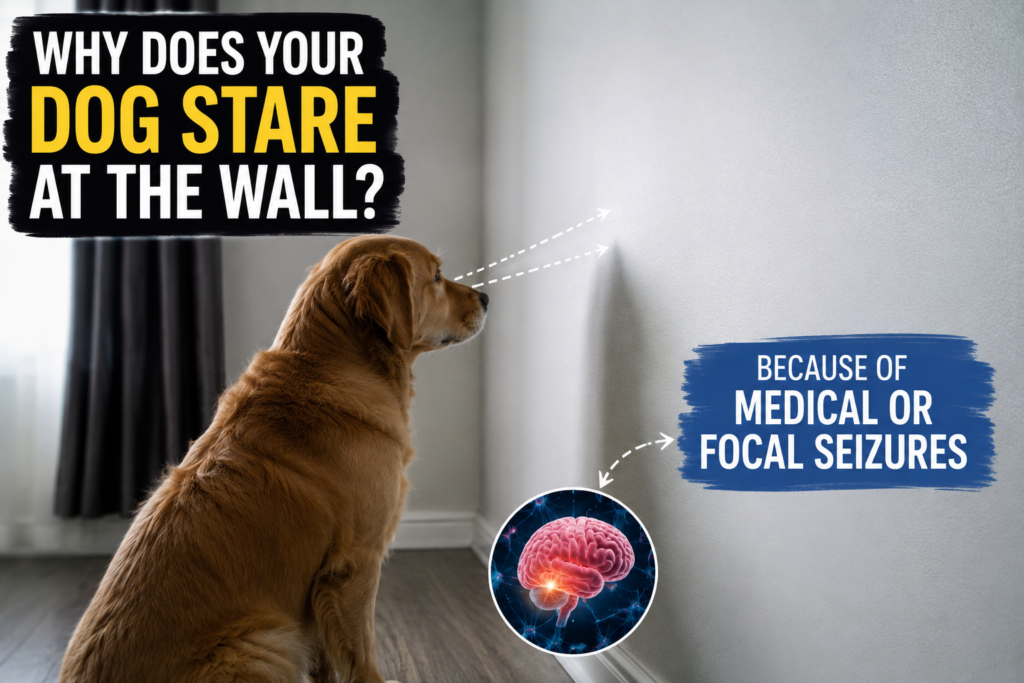
While sensory tracking explains many cases of wall staring, a blank stare can also point toward serious medical realities. Here is what almost no one tells you in the comment sections of viral videos: a dog staring blankly at a wall can actually be in the middle of a seizure.
This is not the kind of seizure with shaking, falling, and foaming at the mouth, but rather a focal seizure (sometimes called a partial seizure) that affects only one small region of the brain. During a focal seizure, abnormal electrical activity fires in one specific zone while the rest of the brain continues running normally. The dog stays upright, looks awake, and looks from the outside like it is watching something invisible because the misfiring brain is generating a sensation, visual disturbance, or emotion with no source.
The most commonly affected region in canine focal seizures is the temporal lobe, which governs emotion, sensation, and memory. When a focal seizure fires there, the dog may experience sudden unexplained fear, a strange smell that isn’t there, or a visual flicker, leaving them with no way to communicate it except to stare. These unobserved focal seizures make it significantly harder for veterinarians to diagnose early if owners simply laugh them off. In rare cases, blank staring and sudden behavioral changes can even be the first and only early signs of frontal or olfactory lobe brain tumors presenting with focal seizures.
Canine Cognitive Dysfunction (Dog Dementia)
As dogs age, another neurological possibility arises. Canine cognitive dysfunction is the canine equivalent of dementia in humans. This condition affects 28% of dogs between 11 and 12 years old, and by the time a dog reaches 15 or 16 years old, that number climbs dramatically to 60%—meaning 6 in 10 senior dogs experience it.
One of its earliest and most consistent signs is blank staring. Dogs with cognitive dysfunction get stuck, staring at walls, walking into corners, and failing to figure out how to turn around as they lose track of where they are and who they are with. Most owners living with this have no idea what is happening, thinking the dog is simply getting old or slowing down rather than recognizing a distinct medical condition.
Canine Compulsive Disorder and Chronic Stress
There is also a possibility rooted in the neurology of stress rather than seizures or cognitive decline. Canine compulsive disorder produces intense, hard-to-interrupt staring episodes in dogs who are chronically under-stimulated, chronically anxious, or who have been accidentally rewarded for the behavior.
Although the mechanism is different from a focal seizure, the behavior from across the room looks nearly identical and is far from harmless. Compulsive staring driven by chronic stress serves as a nervous system signal indicating that the dog is suffering in a way that looks deceptively peaceful from the outside.
How to Tell the Difference: 3 Crucial Signals Every Owner Should Know
- Because multiple causes can wear the exact same face, you cannot easily diagnose the root cause at home, but you can observe specific signals that separate benign curiosity from a medical issue requiring professional veterinary care:
- Duration: A dog briefly investigating a sound glances and moves on, whereas an episode lasting more than 30 seconds without natural resolution is worth noting.
- Interruptibility: Call your dog’s name, offer a treat, or make a sudden clear sound; a dog experiencing normal canine curiosity will break the stare and look at you, while a dog in the middle of a neurological event often cannot and the stare holds.
- Post-Episode Behavior: Watch the 30 seconds following the episode to see if the dog seems slightly disoriented, drinks water excessively, or acts clingy or dazed in a way that doesn’t fit the moment (known as the post-ictal phase).
- If you see duration, uninterruptibility, and post-episode confusion occurring together, call your veterinarian without panicking and without waiting to see if it happens again. When it happens again, film it—not for social media comments or laughs, but because a home video of a suspected focal seizure is one of the most diagnostically valuable things an owner can bring into a clinic. Your phone pointed at your dog becomes a medical instrument, turning an everyday viral impulse into something that can protect your dog’s health.