
Are you worried about Dog Parvovirus breaking out in your kennel or home? If you manage a large pack of 20 to 25 dogs or just welcomed a new puppy, understanding Dog Parvovirus is the absolute line between life and death.
As someone managing a large pack of dogs, seeing firsthand how devastating this virus can be changes your entire approach to kennel hygiene.
In this guide, professional veterinary protocols are combined with real-life management experience to help you save your puppy.
Table of Contents
1. The One-Glance Diagnostic Rule for Dog Parvovirus
2 . Complete Symptoms & Gut Pathophysiology
3 . The Truth About IV Fluids & Saline Drips
4 . The Dangerous Parvo Relapse (The Joy Trap)
5. 3 Immediate Steps to Save Your Puppy’s Life
6. Emergency Home First-Aid (When a Vet is Unavailable)
7. Professional Veterinary Medical Protocols
8 .Mass Prevention & Disinfection Protocols
The One-Glance Diagnostic Rule for Dog Parvovirus
You do not always have to wait for an expensive laboratory panel to suspect a Dog Parvovirus infection. If a dog matches the risk profile below, assume an emergency immediately.
High-Risk Profile Checklist
- The Age Window: Puppies between 50 to 120 days old are the most vulnerable targets.
- The Seasonal Spike: The virus thrives aggressively during peak transitional months (specifically February, March, and April).
- The Clinical Triad: Persistent vomiting, sudden severe diarrhea, and an initial high fever occurring simultaneously.
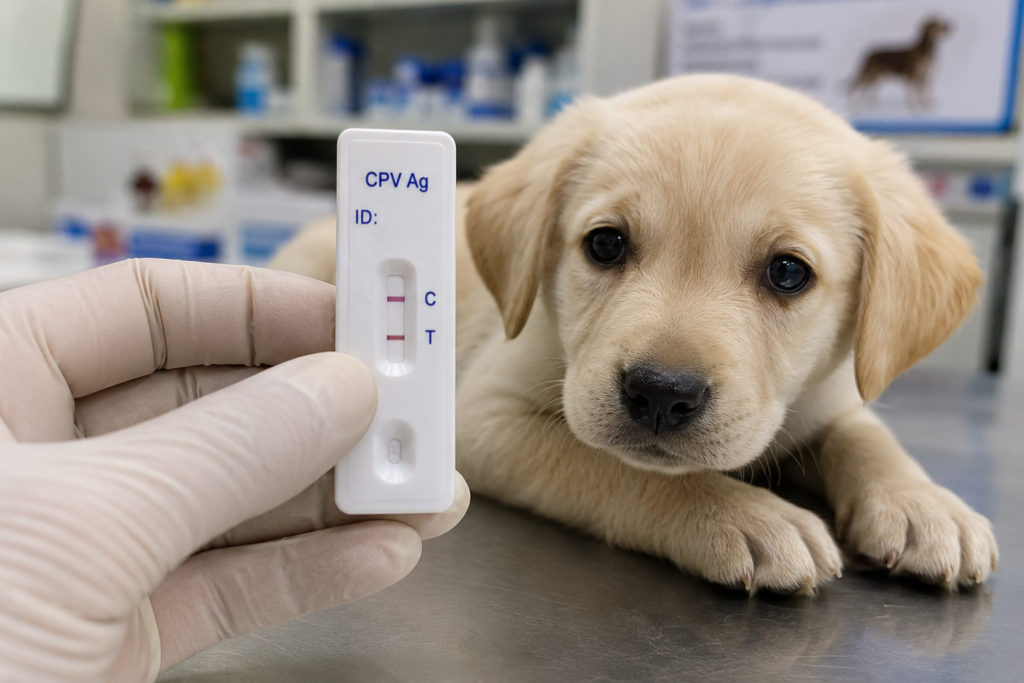
Do not wait for bloody stools to manifest. The moment a high-risk puppy refuses meals and vomits for the first time, run a Dog Parvovirus Antigen Test Kit using a quick fecal or vomit swab. Catching the infection at the first vomit increases survival odds drastically.
2. Complete Symptoms & Gut Pathophysiology
To defeat Dog Parvovirus, you must understand what it does inside the digestive tract. The virus aggressively attacks the rapidly dividing cells of the internal stomach and intestinal lining.
Parvovirus Attack
This massive destruction leaves the intestinal wall completely raw and open, causing blood to leak straight into the digestive tract.
Critical Clinical Signs of Canine Infection
Early Phase Indicators
Total loss of appetite, acute lethargy, choosing isolated corners, and a sudden high fever spiking over 103.5°F.
Advanced Phase Indicators
Continuous clear or frothy vomiting, dark red bloody diarrhea with a highly distinct, foul, metallic odor, and extreme dehydration.
Terminal Phase Indicators
Severe anemia, toxic shock (septicemia) from bacteria entering the bloodstream, and a sudden drop in body temperature below normal as internal organs begin failing.
3. The Truth About IV Fluids & Saline Drips
A common question pet owners ask is: How many fluid drips does a puppy need to survive Dog Parvovirus? There is no single fixed number, because the virus itself does not directly kill the dog—the extreme dehydration and fluid loss caused by the virus are what prove fatal.
Managing the Fluid Timeline
The Lifeline
Intravenous (IV) saline lines are mandatory to replace the massive water loss in the blood.
Variable Duration
Stronger puppies may stabilize after 2 fluid sessions, whereas puppies with low baseline immunity often require aggressive lines for 5 to 7 consecutive days.
The 2-Day Activity Rule
Never stop fluid therapy prematurely just because vomiting slows down. Keep the dog on supportive IV fluids until they display consistent active behavior for 2 full days—meaning they are barking, walking around, playing, and holding down zero symptoms.
4. The Dangerous Parvo Relapse (The Joy Trap)
The “Joy Trap” is a critical mistake where owners celebrate too early. When a puppy stops vomiting for a day, owners assume the Dog Parvovirus has cleared and immediately offer solid food or treats.
This sudden solid load hits a highly damaged, raw stomach lining, causing an immediate, violent relapse. A Parvo relapse is far more lethal than the initial infection because the puppy’s immune reserve is already entirely depleted.
Post-recovery care must transition through a strict, ultra-gentle fluid-to-soft dietary reintroduction protocol.
5. 3 Immediate Steps to Save Your Puppy’s Life
The moment you suspect or confirm a Dog Parvovirus infection, execute these three steps immediately:
- Enforce Strict Fasting (NPO): Nothing Per Os (nothing by mouth). Absolutely zero food, water, or oral liquids. The raw stomach cannot process it and oral intake will only trigger more vomiting.
- Administer Emergency Tongue Drops: Use specific veterinary sublingual Parvo homeopathy drops directly onto the tongue. These absorb through the mucous membranes, completely bypassing the damaged stomach.
- Establish an Emergency Medical Line: Get the puppy to a professional veterinary clinic to initialize a continuous fluid access line.
6. Emergency Home First-Aid (When a Vet is Unavailable)
Disclaimer: Professional veterinary care is the primary standard for Dog Parvovirus. However, if you are located in a remote area or lack immediate clinical access, utilize this scientific home stabilization protocol.
Step-by-Step Home Protocol
Establish the Anti-Vomiting Barrier
Any liquid oral medicine given to a parvo-infected dog is instantly rejected. You must stop the vomiting reflex at the brain and nerve level first. Apply 3 to 4 quick sprays of Emipet Spray (Ondansetron) directly onto the puppy’s tongue. It absorbs via oral tissues into the bloodstream within 15 minutes.
Target the Secondary Gut Infections
Exactly 15 minutes after the spray has taken effect, administer oral Flagyl Syrup (Metronidazole).
The standard clinical baseline is 1 mL per 3 kg of body weight divided into 2 to 3 daily doses (or a standard 2-spoon dose for larger dogs).
This targets anaerobic bacterial overgrowth and opportunistic parasites inside the weakened gut wall.
Control Fever and Body Pain
Dog Parvovirus induces excruciating abdominal cramping, deep fever, and joint stiffness.
Administer Melonex Oral Drops (Meloxicam) at an exact ratio of 1 drop per 1 kg of body weight once or twice daily.
Ensure this is only given after the anti-vomiting spray has successfully blocked the vomiting reflex.
Introduce Micro-Hydration
If, and only if, the puppy successfully stops vomiting for several hours and shows capacity to retain fluids, introduce small sips of an electrolyte solution like Pet Energy Powder dissolved in clean water.
Administer tiny amounts via a syringe every 30 minutes to replenish lost glucose, prevent energy crashes, and block fatal dehydration.
7. Professional Veterinary Medical Protocols
Inside a professional veterinary clinic, a doctor will manage Dog Parvovirus using an intensive, multi-channel supportive care strategy
| Treatment Type | Specific Medications Used | Clinical Purpose |
| Fluid Therapy | Ringer’s Lactate / Normal Saline (Twice Daily – Morning & Evening) | Restores blood volume, maintains hydration, prevents organ shutdown. |
| Anti-Emetics | Injectable Ondansetron / Maropitant (Cerenia) | Blocks central and peripheral emetic receptors to stop vomiting |
| Gastro-Protection | Injectable Ranitidine (Aciloc) / Pantoprazole | Reduces gastric acid production, protects raw stomach ulcers |
| Antibiotic Shield | Cefotaxime / Amikacin / Ceftriaxone | Prevents systemic sepsis via damaged, porous intestinal walls |
| Biological Therapy | Hyperimmune Serum (Canglob P) | Administered at 4.4 mg per kg for 5 days to neutralize systemic virus particles. |
8. Mass Prevention & Disinfection Protocols
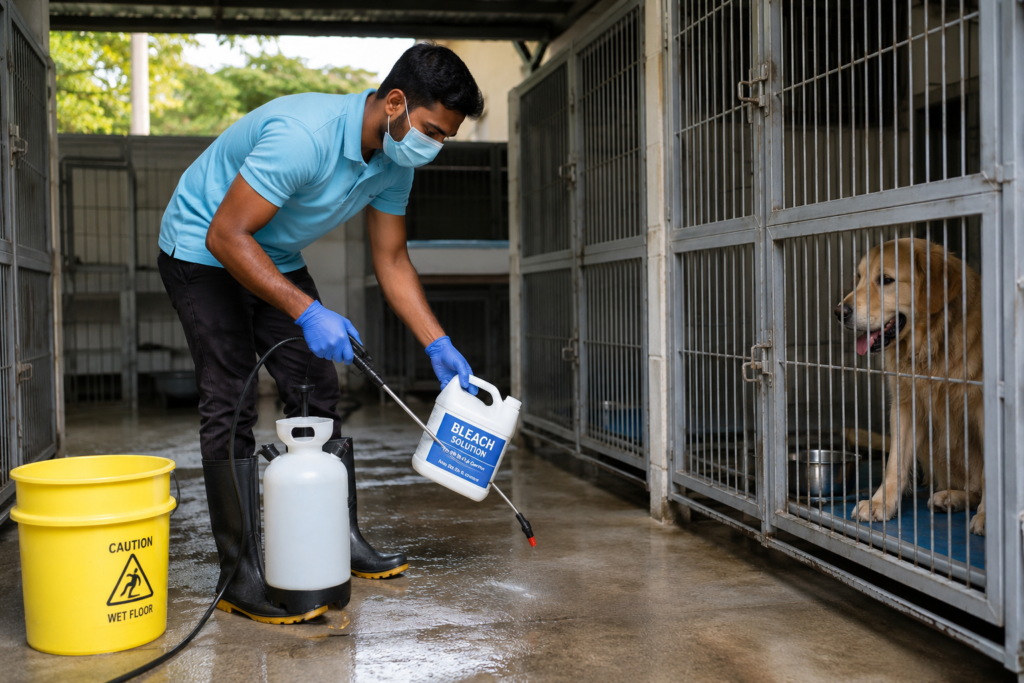
If you manage a large pack of 20 to 25 dogs, a single case of Dog Parvovirus can turn into a devastating outbreak. You must run a strict bio-security operation.
The Mass Pack Protection Strategy
Facility Isolation Protocols
Move any symptomatic dog to a completely separate quarantine facility or isolated room with zero shared spaces, shared food bowls, airflow, or drainage.
Chemical Elimination Standards
Sodium Hypochlorite Application
Standard floor cleaners, standard household detergents, and regular phenyles do not kill Parvovirus. The virus is structurally dheet (resilient) and requires a dedicated chemical agent.
You must wash all cages, concrete floors, and feeding equipment with a Sodium Hypochlorite (household bleach) solution mixed thoroughly with water.
Mixing and Dilution Safety Check
Always wear protective gloves and ensure proper room ventilation during the chemical dilution process to keep the remaining pack safe from respiratory distress or chemical burns.
The 4-Shot Immunization Standard
Never rely on a single vaccine dose. To protect against Dog Parvovirus, a puppy must complete a full 4-shot series: the initial protective shot followed by 3 timely booster doses spaced across their early development weeks. Keep all partially vaccinated puppies completely away from public ground surfaces, parks, and foreign dogs to eliminate exposure vectors.